
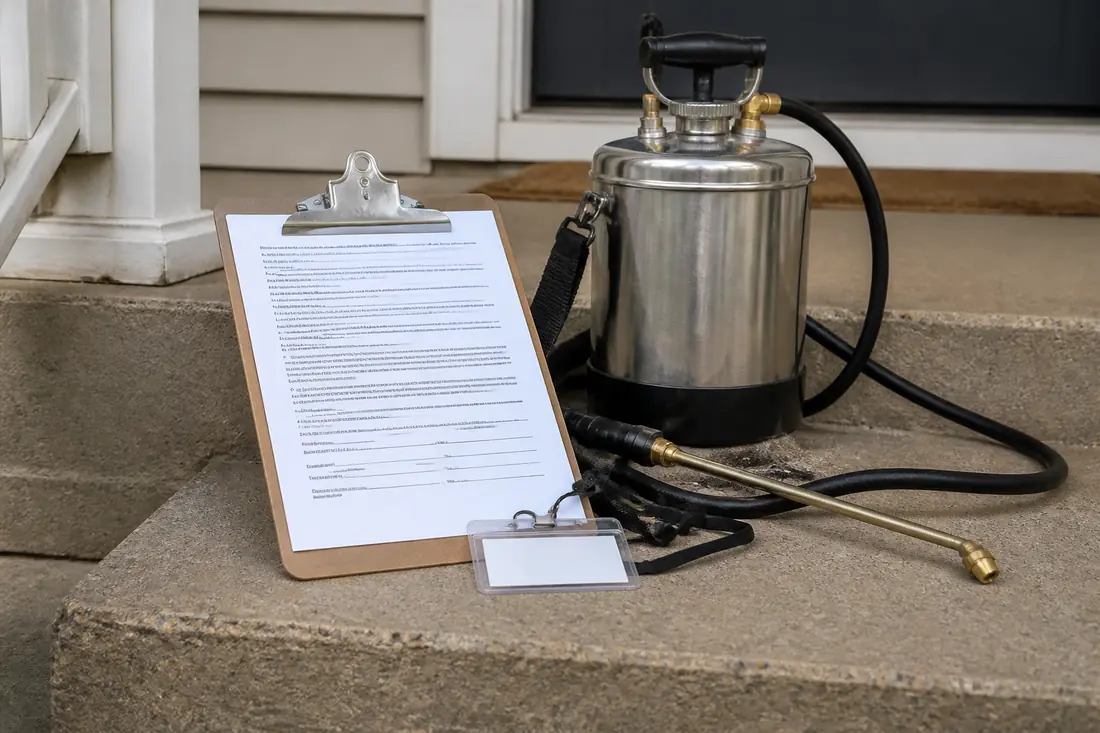
You are standing at the door with a swarm in the garage or a closing date in eleven days, and somebody has quoted you a number. You ask whether they are licensed. They say yes. Everybody says yes.
The answer is close to meaningless, because Texas does not issue one pest control license and then hand it round. It issues two different credentials that do two different jobs, and a company needs both. Asking about one of them tells you very little about the other.
The whole check takes about ten minutes, it is free, and the records are public. It is the most direct piece of due diligence available to you before any chemical touches your house.
Last reviewed: 3 September 2026 against the Texas Department of Agriculture’s published licensing material.
Two credentials, not one
The business license belongs to the company. TDA is explicit about the scope:
Any person engaged in the business of structural pest control must secure a business license from the SPCS for each business location, including branch offices.
Each location. A company operating from three offices does not run on one license, and a license issued to a head office does not cover a branch across town.
The certified applicator license belongs to a person. And this is the requirement most homeowners have never heard of:
Each commercial business license holder must designate a commercial certified applicator, registered with the business, as the responsible certified applicator for the business.
So behind every licensed pest control business there is a named individual carrying the technical responsibility. Not a department. A person, registered to that company.
The rule that stops the credential being borrowed
Then comes the part worth understanding, because it closes an obvious loophole. TDA states that the responsible certified applicator
may not be serving as a responsible certified applicator for any other business licensee or any other business license location.
One person, one business, one location.
That prevents a licensed applicator from acting as a shared credential for several companies at once. If a business is genuinely licensed, someone is standing behind it exclusively — and that person can be looked up.
It also means the question worth asking is not “are you licensed” but:
Who is the responsible certified applicator for this business, and at which location?
A legitimate company can answer it, though it may need to check which applicator is designated for the location serving you. It is not confidential information; it is the basis on which they are permitted to work at all.
What the Act actually covers
The scope is broader than most people assume:
The Structural Pest Control Act (Chapter 1951 of the Occupations Code) requires licensing of businesses and individuals that perform structural pest control for hire.
“For hire” is the hinge. It also reaches beyond contractors: licensing extends to government employees applying pesticides as part of their duties, and to people performing pest control at apartments, day-care centers, hospitals, nursing homes, hotels, motels, lodges, warehouses, food-processing establishments and schools.
Which is a useful thing to know if you manage or live in any of those. The maintenance technician spraying an apartment complex is inside the licensing framework, not outside it.
TDA also issues technician and apprentice licenses for staff working under a certified applicator. An apprentice is not an unlicensed worker — the category exists and is registered — but the responsibility sits with the certified applicator above them.
Categories, and why termite work is different
A certified applicator is licensed in specific categories rather than in pest control generally. Termite work, general pest, lawn and ornamental and others are separate certifications.
This is the practical distinction. A company in good standing for general pest work is not thereby certified for termite work — and termite work is where both the money and the structural consequences sit. If the job is a termite treatment or a termite inspection, the category is the thing to confirm, not the existence of a license.
The ten-minute version
before the visit, not during it:

  1  get the exact business name and license number
  2  check the business license in TDA's current license records
  3  ask who the responsible certified applicator is — then check that person
  4  confirm the category covers the work being proposed
Step 3 is the one nobody does, and it is the one the framework is built around.
Reluctance to provide a license number is itself information.
What the license actually certifies
Checking that a license exists is worth doing. Knowing what standing behind it required is what makes the check mean something.
A certified applicator in Texas does not simply apply and pay. The Department sets an experience floor first: at least six months as a technician together with at least 12 of the last 24 months employed in pest control duties under supervision. There is an alternative route through at least twelve months out of the past twenty-four of verifiable pest control industry experience. Either way, somebody holding the license has been in the trade for a documented period, not since Tuesday.
Then the exams. A General Exam plus one exam in each category being sought, with a pass mark of 70 percent or more. Structural fumigation carries its own prerequisite of 40 hours of training before the exam. The licensing fee is $125.00, and the license expires annually, timed to coincide with the business license.
Staying licensed is its own requirement. Each recertification period calls for two CEUs in general training plus one in each category held, and of the two general units at least one has to be in federal and state laws, pesticide safety, environmental protection or integrated pest management. Self-study and internet courses are permitted every other year rather than continuously.
There are also housekeeping obligations with real deadlines — a change of address or a change of employer has to be filed within 10 days of the effective date.
Why any of this is your business as a homeowner. Those seven categories exist because the work is not interchangeable. Pest control, termite control, lawn and ornamental, structural fumigation, commodity fumigation, weed control and wood preservation are separately examined, and a license in one is not competence in another. When you are quoted for termite work, the category is the question, not whether a license exists at all. A company can be entirely legitimate and still not be licensed for the thing you are asking it to do.
What a license does not tell you
A current license establishes that the legal requirement has been met and the certification behind it kept up. That is the floor, and it is worth confirming.
It is not a quality rating. Two properly licensed companies can propose different approaches to the same infestation and both sit well inside their credentials.
It also says nothing about the contract. On termite work particularly, what is warranted, for how long, what triggers a re-treatment and what happens when the property changes hands are commercial questions rather than licensing ones, and they vary a great deal between companies.
On whether it is safe
The most common question after “are you licensed” is whether a product is safe around children or pets.
That depends on the specific product, where and how it is applied, and the re-entry interval on its label — not on a general assurance. Pesticide labels carry legally binding directions and the applicator is required to follow them. Asking which product is proposed, and for the label information, is a reasonable request and a far more useful one than any blanket answer.
Treat a blanket safety guarantee with caution. The label governs, and the label is specific.
Why it is worth the ten minutes
This work gets bought under pressure — a swarm, a closing date, something moving in the wall at night. Pressure is exactly when verification gets skipped, and it is exactly when a company relying on not being checked finds its customers.
The licensing framework exists because regulated products are being applied to occupied buildings by people the occupants cannot assess. The record is public precisely so it can be checked.
Ten minutes before the visit removes one of the few risks on this job that is entirely avoidable. Scope and warranty terms deserve the same attention, and neither of those appears on a license.
This guide explains the licensing framework in plain language and is not legal advice. The Texas Department of Agriculture’s current requirements and its records for a specific licensee control what is actually the case.
Sources
- TDA — Structural Pest Control Business — source of the per-location licensing requirement, the responsible certified applicator designation and the exclusivity rule
- TDA — Structural Pest Control Licensing — source of the Chapter 1951 scope and the facility list
- TDA — Structural Pest Control Reports: Current Licenses
- TDA — SPCS Certified Applicator Licensing — source of the six-month technician and 12-of-24-month supervised experience requirements and the alternative twelve-of-twenty-four-month industry route, the General Exam plus category exam structure and the 70 percent pass mark, the 40 hours of training required before the structural fumigation exam, the $125.00 licensing fee and annual expiry, the two general CEUs plus one per category with at least one general unit in laws, safety, environmental protection or IPM, the every-other-year limit on self-study, and the 10-day deadlines for a change of address or employer